Analysis of Swatch's “Bioceramic” Material: An Apparent Balance Between Luxury and Practicality
Executive Summary
Bioceramic is a proprietary ceramic-polymer composite material developed by Swatch, combining approximately 2/3rds zirconium-oxide ceramic with 1/3rd bio-sourced castor oil polymer. The ceramic component preserves many of the hardness, scratch resistance, and aesthetic characteristics associated with luxury ceramic watchmaking, while the polymer component improves toughness, enables injection molding at scale, and dramatically lowers production costs. This results in a composite (still primarily ceramic) material that occupies a deliberately engineered middle ground: more refined and premium than a standard polymer/resin, less brittle than pure ceramic, and manufacturable in ways that pure ceramic never could be. Bioceramic's ultimate purpose is to make luxury-associated material characteristics financially attainable for mass-market consumers, while also improving on pure ceramic's practical limitations.
1. Background & Context
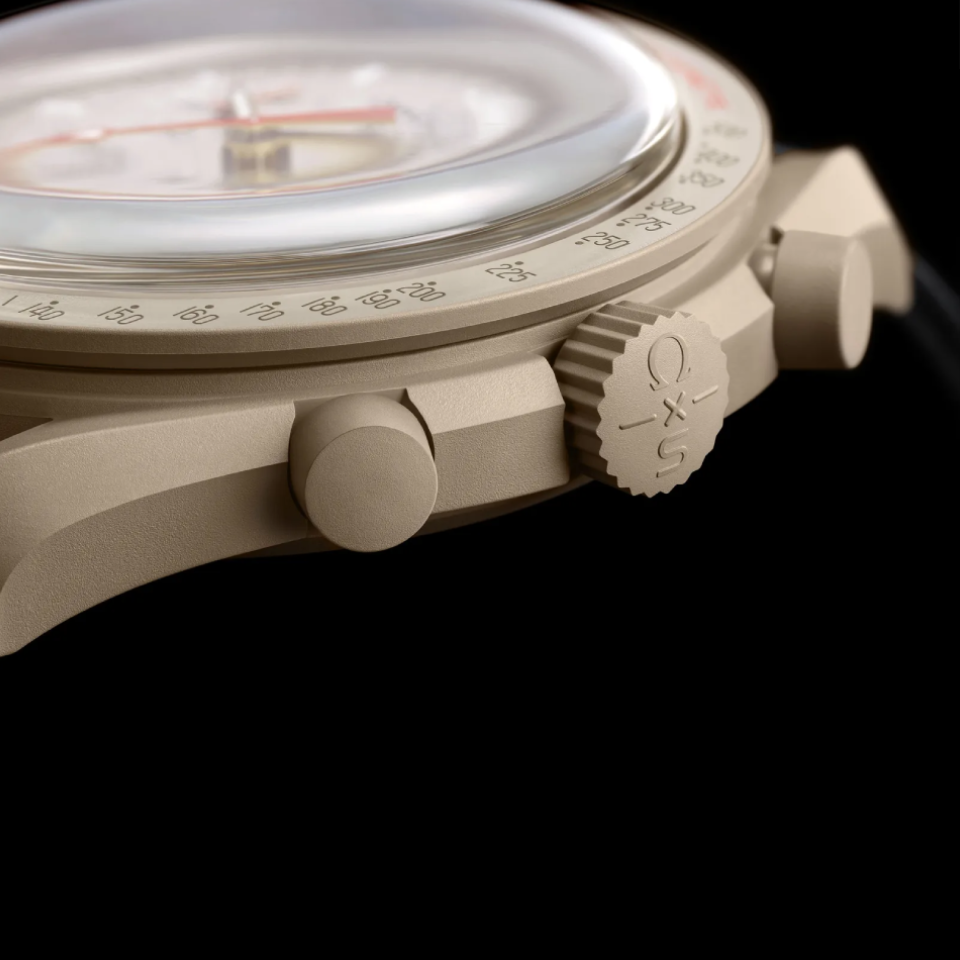
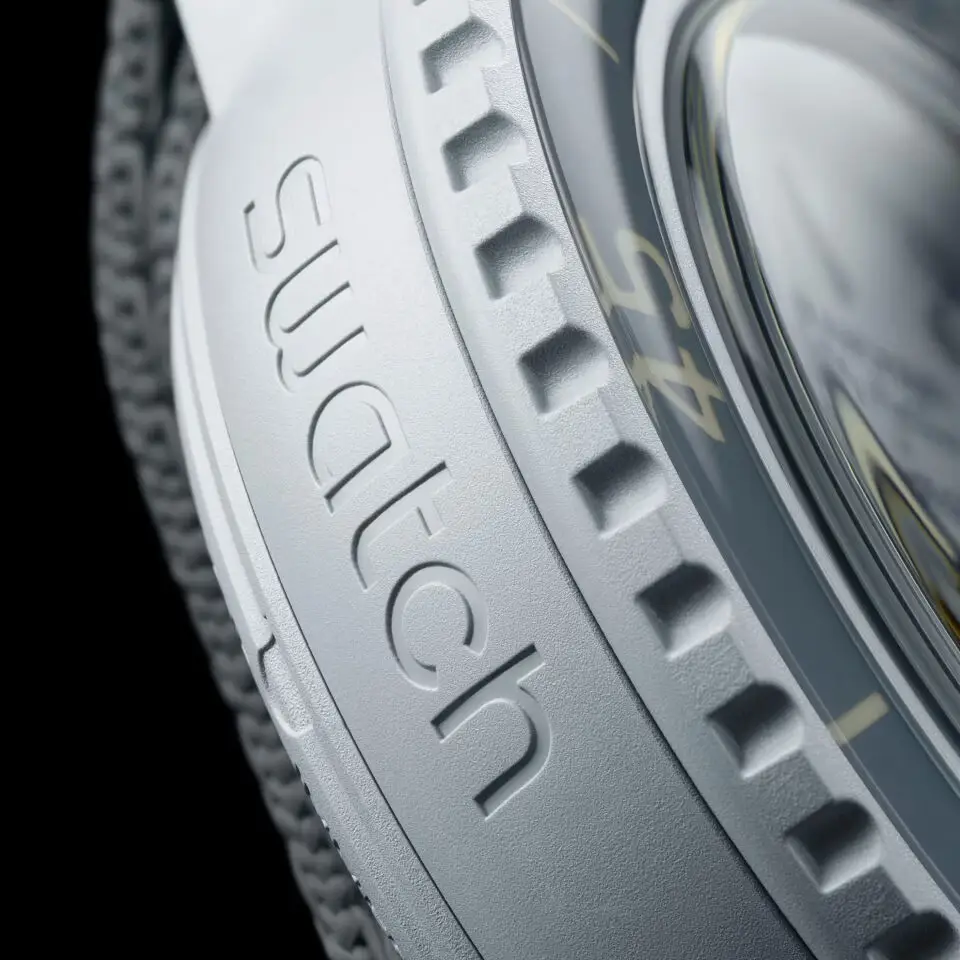
Bioceramic is a proprietary material designed by Swatch, a Swiss watch company owned by the Swatch Group, one of the biggest watch manufacturers in the world. The Swatch Group also holds numerous luxury watch brands as subsidiaries, including Omega, Blancpain, Breguet, and Glashütte Original. Bioceramic is used in Swatch original timepieces as well as in Swatch products designed in collaboration with other brands. One example is the MoonSwatch, developed in collaboration between Omega and Swatch as a more financially attainable homage of Omega's Speedmaster Professional, the first watch on the Moon.
Bioceramic consists of roughly 2/3rds zirconium-oxide ceramic powder, the same advanced ceramic used in some of the highest-end luxury watches, as well as a 1/3rd bio-sourced castor oil polymer. This makes Bioceramic a ceramic-polymer composite material with several unique and beneficial attributes, even over pure ceramic.
2. The Ceramic Side
As mentioned, Bioceramic is composed primarily of ceramic, or zirconium dioxide ($\mathrm{ZrO_2}$). The average person may initially assume that this is the same type of ceramic used in household items, but this is not true. It is advanced engineering ceramic used in some of the highest-end luxury watches in the world, as well as components on aerospace vehicles, cutting tools, and even inside of the human body as dental implants or hip replacements, all because of its unusually strong mechanical properties. Zirconia, in particular, is special as it largely solves the problem of brittleness and being prone to sudden catastrophic failure that many ceramics suffer from. This is a primary reason for its dominance in luxury timepieces.
One of the most important properties of zirconia is a mechanism called transformation toughening. When a crack begins forming inside zirconia, stress at the crack tip can trigger microscopic crystal phase changes. Specifically, tetragonal crystals transform into monoclinic crystals, causing localized volume expansion. This creates compressive stress around the crack, partially blocking it or slowing it down. Very simply, the material itself fights crack propagation internally, potentially without you ever knowing it. This is why many refer to zirconia as "ceramic steel" or simply the toughest ceramic: most ceramics simply crack and shatter with minimal effort, while zirconia actively fights it.
The ceramic used in Swatch's Bioceramic is also very resistant to scratches and general degradation. It has a Mohs hardness of around 8.5, and a Vickers hardness of roughly 1200–1400 HV. For comparison, stainless steel is typically around 5–6 Mohs and 200 HV. Metals scratch because they physically deform, as atoms shift position permanently under force. In ceramics, however, atomic bonds are stronger and more rigid, and surface material does not easily displace under contact stress. These are large factors in why pure ceramic watches still look visually new after many years of use: they are practically scratch-proof and often rightfully marketed as such.
However, even with zirconia's transformation toughening, brittleness comes alongside hardness. Harder materials are often less tough, and less toughness means less energy absorption before fracture. Simply, ceramics generally cannot bend much. Microscopic flaws concentrate stress, cracks form, and they can subsequently spread, sometimes rapidly, sometimes slowly, often leading to catastrophic failure of the material. The general rule is: steel dents, polymers flex, and ceramics crack.
Zirconia also contributes several smaller but nonetheless important qualities associated with luxury watchmaking. It maintains low thermal conductivity, strong chemical resistance, remarkable UV stability, and resistance to corrosion and oxidation. Ceramic watches, as a result, maintain color nearly perfectly, do not corrode like metals, and feel warmer and smoother on the wrist than steel. Bioceramic's composite construction is designed to selectively preserve these desirable properties while offsetting many of zirconia's inherent limitations.
3. The Polymer Side
The 1/3rd castor oil component of Bioceramic is what makes the material feasibly manufacturable and commercially viable at Swatch's scale. Swatch's Bioceramic uses a biosourced polymer derived from castor oil. Despite the "bio" terminology, this component is still fundamentally a polymer plastic, though the differentiating factor is its origins in renewable castor plant oil rather than petroleum feedstocks. Castor oil excels for this purpose because the plant is naturally drought-resistant, requires relatively low agricultural resources, and has minimal competition with food production.
From an engineering perspective, the polymer plays a critical role in the composite. Polymers generally express behavior inverse to that of ceramics: softer and less scratch-resistant, yet significantly more flexible and capable of dissipating energy under stress. The polymer matrix helps absorb impacts, distribute stress more gradually, and reduce the likelihood of catastrophic failure. This, in practice, makes Bioceramic substantially less fragile than a pure ceramic watch case.
The polymer component also massively simplifies the manufacturing process. Because of the polymer addition, Swatch can reliably injection mold Bioceramic into highly consistent components at far larger production scales and at significantly lower costs than would be possible with pure ceramic. This significantly contributes to the financial attainability of Bioceramic watches, which is expectedly one of the main public themes of the material.
It should go without saying that the polymer addition does lower overall hardness compared to full ceramic, meaning Bioceramic will not be on par with traditional zirconia watch cases in terms of scratch resistance. Bioceramic occupies a unique position where it is mechanically more advanced than standard resin, yet not entirely comparable to pure ceramic despite having qualities that would, in some aspects, make it preferable over pure ceramic. The polymer integration, while sacrificing a degree of absolute hardness, is ultimately what allows Bioceramic to achieve the toughness, manufacturability, and affordability that would otherwise be infeasible with a pure ceramic construction.
4. The Physical Manufacturing Process
Pure zirconia ceramic watches are typically manufactured through a process involving ultra-fine ceramic powder preparation, high-pressure molding, extremely high-temperature sintering, diamond-tool machining, and extensive polishing and finishing. Sintering alone often requires temperatures exceeding 1400°C, during which ceramic particles fuse into a dense solid structure. However, ceramics shrink during sintering, making dimensional precision difficult to maintain. Zirconia, once hardened, also becomes extremely difficult to machine because of its exceptional hardness, often necessitating diamond-coated tooling and highly specialized finishing techniques. This manufacturing complexity is one of the primary reasons full ceramic watches have remained associated with high-cost, high-end luxury watchmaking.
Bioceramic's polymer integration allows Swatch to take a fundamentally different approach. Rather than producing a fully sintered ceramic structure, Swatch combines zirconia powder with its castor-oil-derived polymer and pigments into a composite feedstock that can be processed similarly to high-performance plastic materials. Unlike traditional ceramic manufacturing, injection molding allows for highly repeatable production, rapid scaling, complex geometry creation, integrated coloration, and significantly lower manufacturing costs.
5. Conclusion
Swatch's Bioceramic ultimately represents a calculated material compromise: ceramic and polymer components actively compensating for each other's weaknesses. The ceramic preserves hardness, scratch resistance, UV stability, and the tactile and visual qualities associated with luxury watchmaking. The polymer improves toughness, impact absorption, and manufacturability at scale. The result occupies an intentionally engineered middle ground between both.
Bioceramic is, notably, as much a financial and commercial decision as it is a material one. Its ultimate goal should be apparent by now: making luxury material characteristics more financially attainable, while proving practically superior in several regards to the pure ceramic it draws from.