June 1, 2026
The Often Misplaced Focus of Americans And Our Dying Infrastructure
It goes without saying that every country has its own set of unique problems and obstacles, and many Americans wouldn't be wrong in pointing out the obstacles that foreign countries face. However, simultaneously, in many instances, I believe this to be a form of deflection, pointing outward to avoid uncomfortable realities inward that have remained chronically unaddressed. I believe we need to focus far more on the state of our own country. When you travel from a major international airport in China to one in the US, you feel like you've traveled 50 years into the past (it of course depends on what airport you're coming from and arriving at, but generally this is true in several regards). You can tell, even from the distinct smell upon arriving. This should not be the case for a country that has the largest economy in the world and is the most powerful in several other regards.
Simply, the US has the largest nominal GDP but ranks embarrassingly low on infrastructure quality. This includes airports, rail, general public transit systems, high-speed internet in rural areas (though this has changed recently because of Starlink), roads, bridges, and even buildings in general. South Korea, Japan, Singapore, and even China (I use the word "even" because it's classified as a developing country) all have far more safe, modern, and cohesive infrastructure nationally. Much of America's infrastructure was built in the 20th century and has sort of been sitting there ever since, awaiting significant upgrades (which is expected as time moves forward) that never came. You can really easily tell, especially after gaining a more global perspective from traveling abroad.
Quite a large number of Americans, in my experience at least, and based on my observations so far, will attempt to turn this into a political issue. Specifically, a partisan issue, being either "it's because of the Democrats" or "it's because of the Republicans." But the reality is, neither truly care, they're both different sides of the same coin, at least when it comes to infrastructure results. They might as well be the same side of the same coin. That said, there are a few fundamental reasons for why America's infrastructure is so far behind.
Infrastructure is, in several cases, a delayed-return investment. A bridge, or a rail line (let alone an entire high speed rail network) built today may pay dividends over 50+ years, but costs a lot of money right now. The political culture in America inherently repels this idea. Political candidates of both dominant political parties (though, Republicans especially) have made it clear that they prefer to focus on tax cuts, rather than pooling tax money for collective investment. This is often seemingly because the individual reward for tax cuts is immediate and legible to citizens, even though the result of funding a 10 year infrastructure project might actually be far more beneficial for citizens and the country as a whole. This is a case of shortsightedness combined with ignorance on all sides (Republicans and Democrats, voters and candidates) and is further evidenced by the fact that a congressman, for example, faces re-election in 2 years, and advocation for a 10-year high speed rail project offers him nothing in his short window as a congressman. This, truthfully, is rational behavior given the nature of the incentive structure, but there's also an argument to be made that this is borderline corruption, when members of Congress care more about their own personal career than the future of the country that they're supposed to be serving. Of course, I'm not saying that's the case for every member of Congress, but it's important to mention this regardless.
It truly feels like America is putting money in all the wrong places. Cohesive, modern airport (for example) infrastructure across a nation requires sustained, patient public capital. The ultra-modern airports in China are state-directed, long-term projects, much like their national high speed rail network. Singapore's Changi Airport is treated by the country as a national asset. American airports are largely dependent on a patchwork of municipal bonds, airline fees, as well as federal grants, which have been chronically underfunded relative to the ambition required, and any meaningfully significant federal investment often becomes a ridiculously messy political war about things like spending and debt. The visible result that this creates is a nation that is incredibly wealthy on paper, yet invests so little in itself (and even when it does, it does so in the wrong ways), that when you walk down the street, you'd never think this is the wealthiest country in the world. Even NASA, a civilian agency operating in the field arguably most crucial for our species' future, is considerably underfunded.
Cohesive national infrastructure requires high-level, coordinated decision-making. The problem is, a high-speed rail line crossing multiple states requires several federal agencies, state governments, regional authorities, and local municipalities, each with their own budgets, priorities, legal frameworks, and political pressures, all seeing eye-to-eye. Any one jurisdiction can significantly slow or potentially kill a project. Of course, the President could oversee this infrastructure effort, pressure local governments, and more, but he can't directly force them. Compare this to say Japan, France, or China, where the central governments (as controversial as they may be) can design a path forward, fund it, and actually build it. American federalism has its strengths in several cases, but for things like a cohesive network of modern infrastructure across the nation, it only results in endless negotiation, repeated efforts, and wasted work. Even when a massive infrastructure initiative is finally launched, it takes far too long and consumes far too much capital than it should, and the result is disappointing anyway.
We are so far behind, and as a result, are missing so much knowledge that we otherwise could have had. Nations which started rapid construction of advanced, modern infrastructure years ago have learned over time how to do it better, cheaper, safer, and more efficiently. Hence, it is becoming increasingly difficult for America to catch up. I mean, honestly, compare the images below (NYC Subway vs Chongqing East Railway Station):
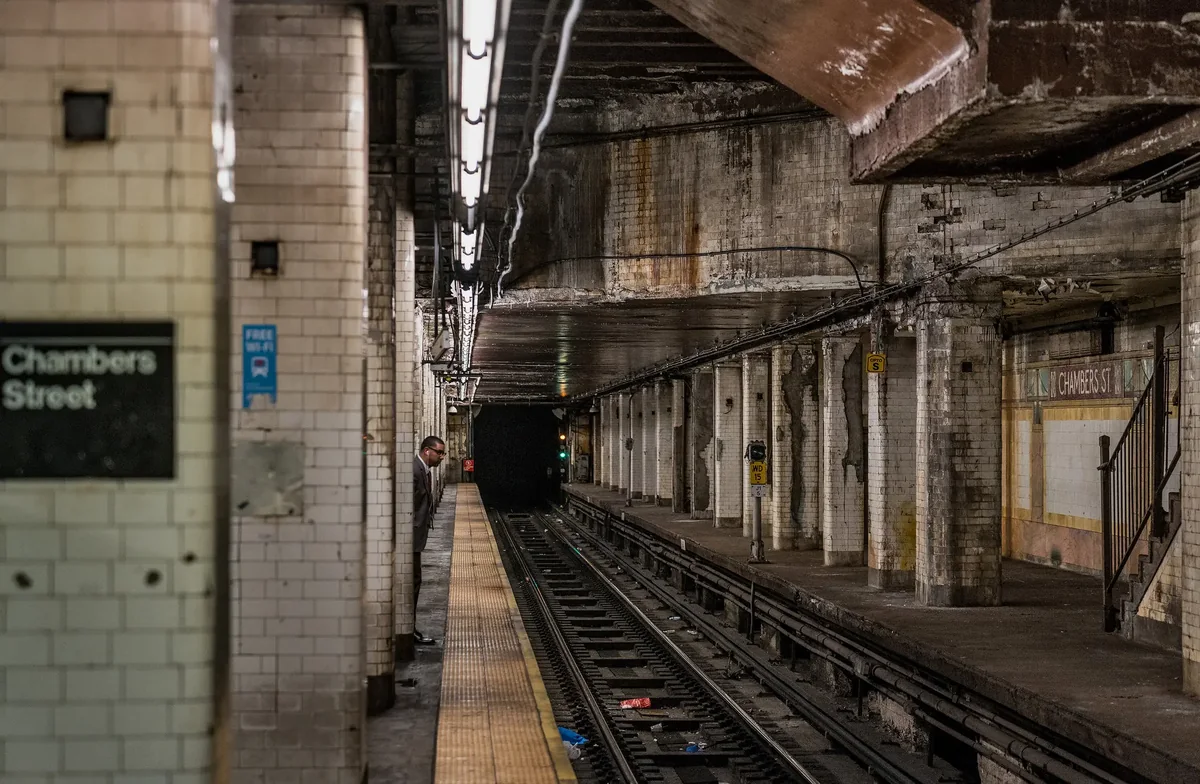
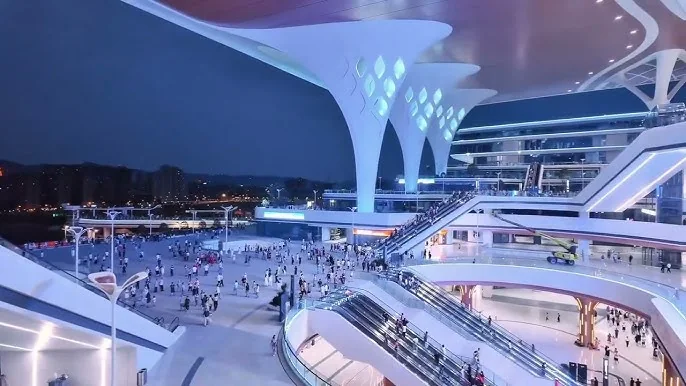
That's just sad, especially for America's de facto economic capital, and especially when comparing it to the infrastructure of other countries. This is just one of countless examples, and it's not just limited to metro/railway stations.
Everything I discussed above, including the tax cut bias, decision fragmentation, and short-term thinking, are downstream of one thing, which is that politicians go where voter attention goes. They naturally chase votes, and if voters consistently rewarded long-term investment in infrastructure and punished short-term ignorance, the situation would change quite rapidly. Unfortunately, however, American voters have (often unknowingly) tolerated and actively rewarded the very behaviors that cause decay. Even voters who are somewhat aware of America's infrastructure problems feel them abstractly but feel tax bills concretely, and politicians know this with precision, taking advantage of it to the maximum.
However, I ultimately believe that America's infrastructure failures are symptoms a more broad cultural neglect, extending into architecture, urban design, and the general quality of shared life. America has quietly (or perhaps not so quietly) accepted a reality where private consumption is world-class but anything shared, collective, or public is often framed as "authoritarian" or "communist" and is left to lag, decay, or simply never reach its potential, and for a country that considers itself the global standard-bearer, that gap between self-image and reality is just a fundamental and deeply sad contradiction that needs to be addressed sooner rather than later, for the future of America.